August 29, 2026•Podcast

Is Schema Therapy Going Back to Its CBT Roots?

Is Schema Therapy Going Back to Its CBT Roots?

Schema Therapy is evolving. The question is: how does it continue to develop without losing the foundations that made it effective in the first place?

In the latest episode of What’s the Schemata?, Chris Hayes and Rob Brockman are joined by Associate Professor Julie Krans, a researcher and psychologist from the Netherlands whose work sits at the intersection of Schema Therapy and CBT.

Julie describes Schema Therapy as being in something of an “adolescent” phase — experimenting with its identity, expanding into new areas and asking what parts of the original model are truly essential.

Her research offers an interesting answer.

Julie works with people experiencing anxiety, OCD and PTSD who have already received guideline treatments such as CBT but have not recovered. Her research explores whether Schema Therapy concepts can help explain why CBT sometimes becomes stuck.

One finding is particularly interesting: the Vulnerable Child mode may interfere with a person’s ability to learn during exposure therapy. If someone becomes overwhelmed during exposure, they may leave the experience still believing the situation is dangerous — even when the exercise was designed to teach them otherwise.

Rather than abandoning CBT, Julie’s team uses Schema Therapy to help people engage with it more effectively.

Schema modes can identify what is getting in the way. Core emotional needs can give exposure exercises more personal meaning. Imagery rescripting can help address earlier experiences influencing the present. CBT then contributes something Schema Therapy can sometimes lack: highly structured behavioural experiments, measurement and systematic testing.

The result is something the episode describes as “schema-informed CBT.”

It is also a reminder that therapies do not have to compete with each other. Decades after Schema Therapy emerged from the cognitive behavioural tradition, some of its most interesting developments may come from bringing those traditions back together.

Listen to the full conversation with Julie Krans on What’s the Schemata?

Latest Courses

December 2nd (2026) Start - Online Course 1 - Schema Therapy: "The Basic Schema Model, Methods, and Strategies" course thumbnail

December 2nd (2026) Start - Online Course 1 - Schema Therapy: "The Basic Schema Model, Methods, and Strategies"

Closing Soon!- Online Course 1 - Schema Therapy: "The Basic Schema Model, Methods, and Strategies" Learn the Foundations of Schema Therapy Practice Online with this 6-Week Program (Great for getting started)

6-8 weeks
Certificate
December 2nd (2026) Start Online Course 2: The Schema Mode Model and Mode Interventions for Complex Cases course thumbnail

December 2nd (2026) Start Online Course 2: The Schema Mode Model and Mode Interventions for Complex Cases

Closing Soon: Online Course 2: The Schema Mode Model and Mode Interventions for Complex Cases

6-8 weeks
Certificate
 (Brand New!!!) Inside the Room: The Schema Therapy Sessions Video Series with Chris Hayes & Rob Brockman course thumbnail

(Brand New!!!) Inside the Room: The Schema Therapy Sessions Video Series with Chris Hayes & Rob Brockman

(Brand New Release!!) 12 Full-Length Schema Therapy Sessions with ISST Accredited Schema Therapists and Schema Supervisors produced by Chris Hayes & Rob Brockman

6-8 weeks
Certificate
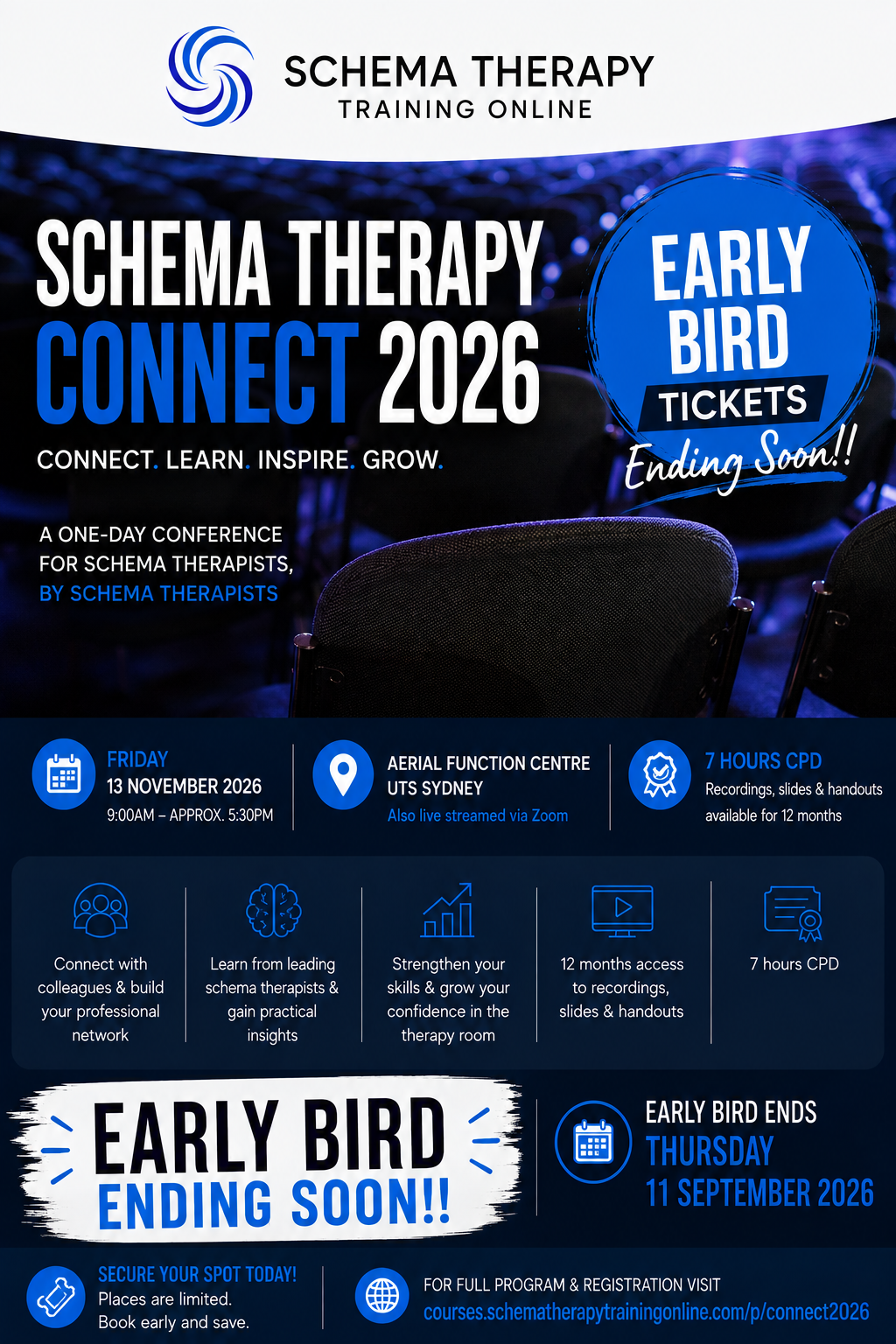
SCHEMA THERAPY CONNECT 2026 1-Day Mini-Conference - Friday November 13th (2026) Live and Online Streaming course thumbnail

SCHEMA THERAPY CONNECT 2026 1-Day Mini-Conference - Friday November 13th (2026) Live and Online Streaming

Connect Conference- November 13th (2026) - Live and Online Streaming

6-8 weeks
Certificate
December 2nd (2026) Start - Schema Therapy for Adolescents and Young Adults course thumbnail

December 2nd (2026) Start - Schema Therapy for Adolescents and Young Adults

This training focuses on the use of Schema Therapy with adolescents and young people. The course explores how early maladaptive schemas and coping modes shape identity, relationships, and emotional wellbeing during the critical developmental stage of adolescence. Participants will learn practical strategies for working with common presentations in youth—such as social withdrawal, perfectionism, emotional dysregulation, and oppositional behaviours—using the schema mode model. The program highlights creative and experiential methods (imagery, role play, and mode dialogues) adapted for young clients, alongside empathic confrontation, limit-setting, and family involvement when appropriate. Emphasis is placed on strengthening resilience, empowering the Healthy Adult mode, and supporting young people to build healthier self-concepts and relationships.

6-8 weeks
Certificate
December 2nd (2026) Start: Imagery Rescripting in Schema Therapy - 16-Hours of Continuing Professional Development course thumbnail

December 2nd (2026) Start: Imagery Rescripting in Schema Therapy - 16-Hours of Continuing Professional Development

Imagery Rescripting for Schema Change (Course 1) Develop Your Imagery Rescripting Skills and Improve Your Confidence with Imagery Interventions for schema change.

6-8 weeks
Certificate