
October 1, 2023News

New Research: Efficacy of Imagery Rescripting
New Research: Efficacy of Imagery Rescripting

New Research: Efficacy of Imagery Rescripting

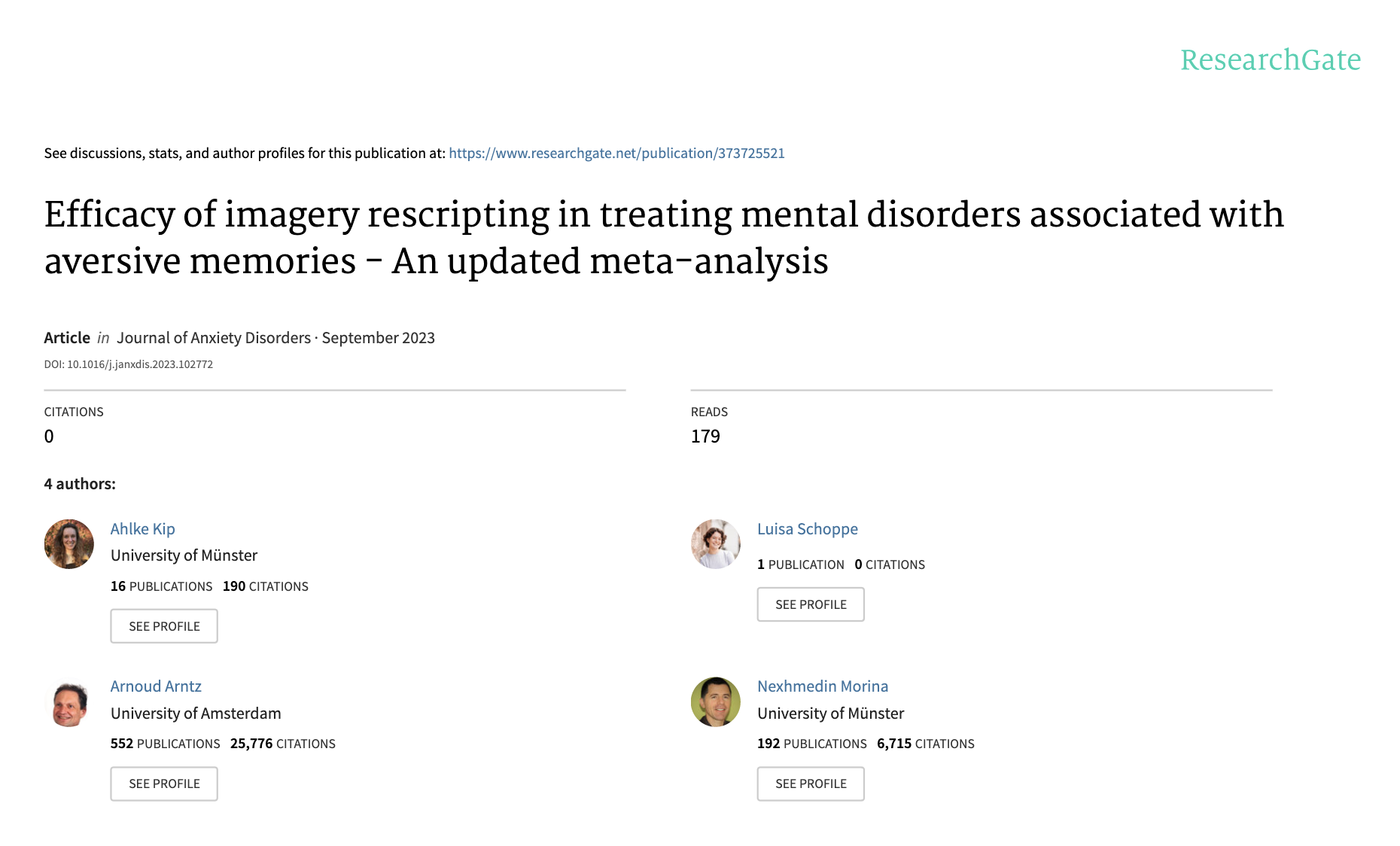
Efficacy of imagery rescripting research paper from ResearchGate

What is ImRs?

Imagine being able to not only revisit and confront distressing memories but to also reshape their course in a way that satisfies your present basic needs. This is precisely what ImRs aims to accomplish.

ImRs represents a significant breakthrough in the field of mental health, offering a means to transform the meaning associated with powerful aversive memories. The impact of such memories extends far beyond the past, as they influence our current and future behavior, playing a pivotal role in the development and persistence of various mental disorders. Whether we consider adverse childhood experiences or the challenges of adulthood, the way we process and represent these events can lead to intrusive memories, avoidance behaviors, and dysfunctional memory appraisals, all contributing to the maintenance of psychological symptoms.

This approach holds relevance not only for conditions like posttraumatic stress disorder (PTSD) but also for a range of other disorders, including depression and social anxiety disorder. The foundation of ImRs lies in the reconsolidation hypothesis, which suggests that previously consolidated memories can be brought back into an active state, allowing for the reinforcement, reduction, or update of their content and associated emotions. It’s important to note that ImRs doesn’t involve replacing original memories with false ones but rather focuses on creating more functional meanings.

The impact of ImRs extends to reducing negative self-beliefs and enhancing feelings of mastery and self-efficacy, bringing about a positive transformation in one’s emotional landscape. This versatile technique can be applied either as a stand-alone intervention or in combination with other treatments, seamlessly integrating into various cognitive behavioral therapies and schema therapy.

Two distinct approaches to ImRs have emerged, one involving cognitive preparation to challenge dysfunctional interpretations of traumatic memories and the other emphasizing the experiential aspect, where the new script is based on spontaneous needs and action tendencies during the imagery. Surprisingly, there has been no direct comparison of these two approaches, leaving room for exploration.

While several trials have explored the efficacy of ImRs in treating various mental disorders, a comprehensive meta-analysis is needed to provide a clearer picture of its impact. With a growing body of research in this field, we aim to conduct an updated meta-analysis, focusing on randomized controlled trials (RCTs) to assess the effectiveness of ImRs compared to control conditions or other psychological treatments. By doing so, we hope to shed light on the true potential of ImRs in reducing psychological complaints and improving mental well-being.
Latest Courses

September 2nd (2026) Start - Online Course 1 - Schema Therapy: "The Basic Schema Model, Methods, and Strategies" course thumbnail

September 2nd (2026) Start - Online Course 1 - Schema Therapy: "The Basic Schema Model, Methods, and Strategies"

Closing Soon!- Online Course 1 - Schema Therapy: "The Basic Schema Model, Methods, and Strategies" Learn the Foundations of Schema Therapy Practice Online with this 6-Week Program (Great for getting started)

6-8 weeks
Certificate
September 2nd (2026) Start Online Course 2: The Schema Mode Model and Mode Interventions for Complex Cases course thumbnail

September 2nd (2026) Start Online Course 2: The Schema Mode Model and Mode Interventions for Complex Cases

Closing Soon: Online Course 2: The Schema Mode Model and Mode Interventions for Complex Cases

6-8 weeks
Certificate
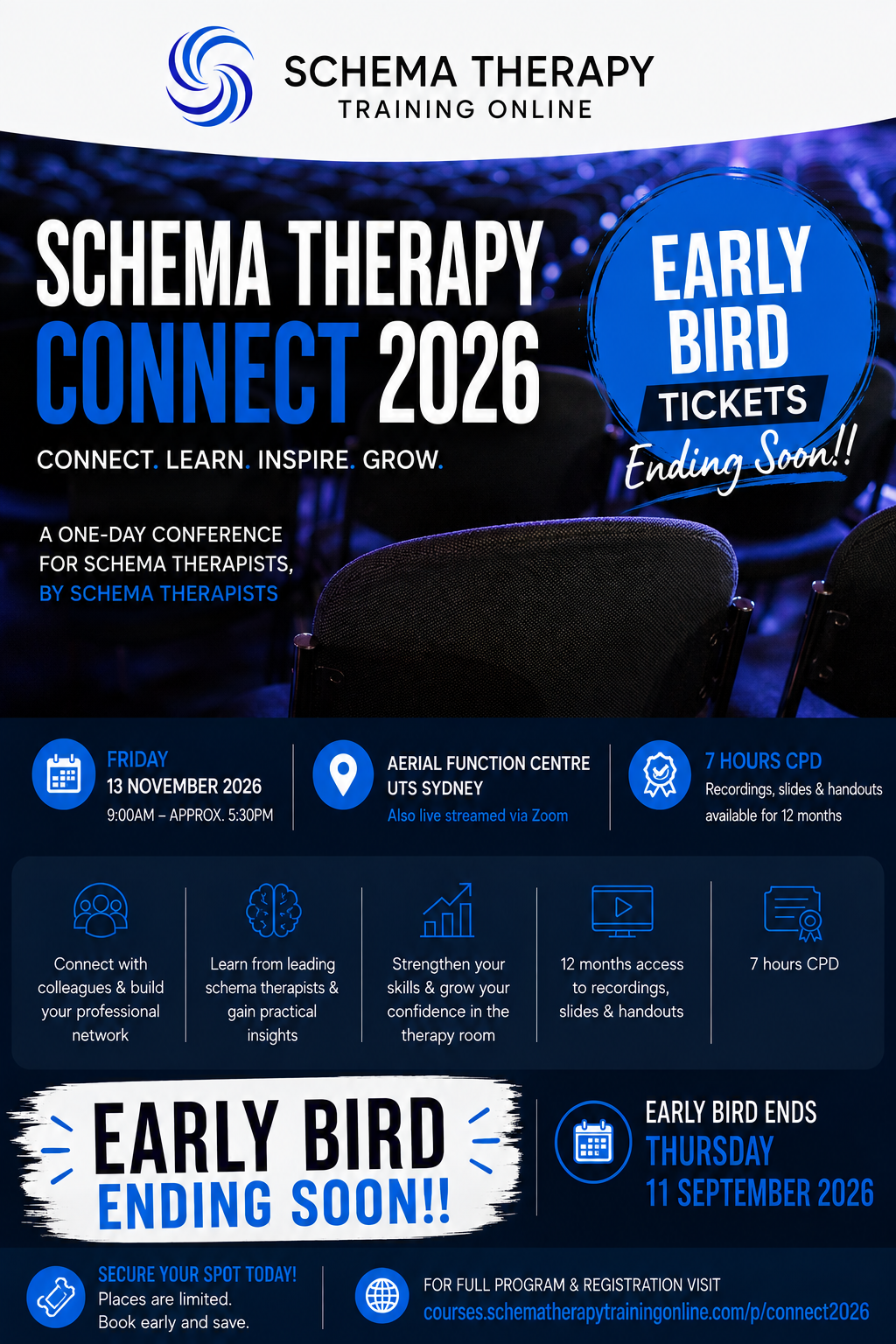
SCHEMA THERAPY CONNECT 2026 1-Day Mini-Conference - Friday November 13th (2026) Live and Online Streaming course thumbnail

SCHEMA THERAPY CONNECT 2026 1-Day Mini-Conference - Friday November 13th (2026) Live and Online Streaming

Connect Conference- November 13th (2026) - Live and Online Streaming

6-8 weeks
Certificate
 (Brand New!!!) Inside the Room: The Schema Therapy Sessions Video Series with Chris Hayes & Rob Brockman course thumbnail

(Brand New!!!) Inside the Room: The Schema Therapy Sessions Video Series with Chris Hayes & Rob Brockman

(Brand New Release!!) 12 Full-Length Schema Therapy Sessions with ISST Accredited Schema Therapists and Schema Supervisors produced by Chris Hayes & Rob Brockman

6-8 weeks
Certificate
Schema Therapy with Autistic and ADHD Individuals: A Neuro-diversity Affirming & Relational Approach course thumbnail

Schema Therapy with Autistic and ADHD Individuals: A Neuro-diversity Affirming & Relational Approach

Delivered Live by Zoom (September 8th, 2026) and with 12-months recording access 7-Hours Continuing Professional Development (CPD)

6-8 weeks
Certificate
(Brand New Webinar!!) November 2 (2026) "Seeing Through a Schema Lens" - Advanced Case Conceptualisation Skills in Practice course thumbnail

(Brand New Webinar!!) November 2 (2026) "Seeing Through a Schema Lens" - Advanced Case Conceptualisation Skills in Practice

Designed for clinicians with foundational knowledge of Schema Therapy, this webinar strengthens the ability to develop nuanced, clinically useful case conceptualisations. Participants will explore the interplay between unmet emotional needs, schemas, coping responses and modes, with particular attention to complex or overlapping patterns. Through applied case material, participants will refine their ability to identify maintaining cycles, test formulation hypotheses and use conceptualisation to guide treatment priorities, intervention selection and the therapeutic relationship.

6-8 weeks
Certificate